Tag: child development

  • Building Strong Relationships with Young Children: The Importance of Attachment

    Building Strong Relationships with Young Children: The Importance of Attachment

    As early years educators, whether you’re a childminder or a nursery practitioner, one of the most important aspects of your role is to create a safe, nurturing and supportive environment for the children in your care. While many parents and caregivers naturally focus on physical needs like feeding, clothing and safety, the emotional needs of children are equally vital for their growth, development and wellbeing.

    At the heart of this emotional support is attachment – the deep emotional bond that forms between a child and their primary caregivers. The quality of these relationships has a significant impact on a child’s overall well-being and development. Understanding and fostering healthy attachment is essential in the early years.

    What is Attachment?

    Attachment refers to the bond that children form with their caregivers, which provides them with a sense of security and safety. This bond is formed through consistent, responsive interactions and builds the foundation for emotional regulation, trust and social development.

    In the early years, children are particularly sensitive to the quality of their relationships. Positive attachment experiences help children feel safe, loved, and understood, which is crucial for their mental, emotional and social development.

    Why Attachment Matters in Early Childhood

    1. Emotional Development: Children who have secure attachments with their caregivers tend to develop strong emotional regulation skills. They learn how to manage their feelings, cope with stress, and express emotions in healthy ways. These children are also better equipped to form positive relationships with others.

    2. Social Skills: Attachment in early childhood lays the groundwork for how children interact with others as they grow. Children with secure attachments are more likely to show empathy, engage in positive social interactions, and develop strong peer relationships.

    3. Cognitive and Language Development: Secure attachment helps create a safe base for exploration and learning. Children who feel secure are more confident in exploring their environment, trying new things, and engaging in cognitive tasks. This exploration and engagement are key drivers of language and cognitive development.

    4. Long-Term Mental Health: A strong attachment bond in the early years can set the stage for healthier mental health outcomes throughout childhood and into adulthood. Children who experience secure attachment are less likely to experience anxiety, depression or behavioural problems.

    How Can Childminders and Nursery Staff Foster Strong Attachments?

    1. Be Consistently Responsive to Children’s Needs: One of the most important ways to foster secure attachment is to be consistently responsive to a child’s physical and emotional needs. Whether it’s offering comfort when a child is upset or providing praise when they achieve something, consistency helps children feel understood and valued.

    • Practical Tip: Respond to verbal and non-verbal cues from the children. If a child reaches out for comfort or needs assistance, try to meet those needs in a calm, caring manner. Over time, this builds trust.

    2. Establish Predictable Routines: Children feel more secure when they know what to expect. Creating a predictable and consistent routine helps children feel safe and reduces anxiety. It’s important to provide structure in the daily schedule, but also to remain flexible to the children’s emotional needs.

    • Practical Tip: Create a visual schedule with pictures that children can refer to throughout the day. This helps younger children, especially those who are non-verbal, understand what’s coming next.

    3. Create a Warm and Inviting Environment: Children need to feel emotionally safe in their environment. A warm, inviting atmosphere allows children to explore and learn, knowing that there is a safe haven they can return to when they need it. Your body language, tone of voice and facial expressions play a large role in this.

    • Practical Tip: Use open body language, maintain eye contact, and speak in a soothing tone when interacting with children. A friendly and approachable demeanor invites children to come to you for support.

    4. Offer Comfort and Reassurance: When children are upset or distressed, your ability to offer comfort and reassurance plays a critical role in strengthening the attachment. Whether it’s through a gentle touch, a cuddle or words of encouragement – children need to feel supported during challenging moments.

    • Practical Tip: When a child is upset, kneel down to their level, acknowledge their feelings, and offer reassurance. Simple phrases like, “I see you’re upset, and I’m here to help” go a long way in making children feel safe.

    5. Be Present and Engage: Quality time spent with children is one of the best ways to form secure attachment. Engage in activities that foster connection, such as reading together, playing games, or simply talking and listening to them. Active engagement helps children feel valued and understood.

    • Practical Tip: Get down to the child’s level during playtime and actively participate. Whether it’s building with blocks or drawing, your involvement helps them feel secure and appreciated.

    6. Encourage Emotional Expression: Allowing children to express their emotions in a safe and supportive environment helps them understand their feelings and develop emotional regulation skills. Recognise and validate their emotions, which helps them feel understood.

    • Practical Tip: If a child is feeling sad, angry, or frustrated, encourage them to talk about their feelings. You might say, “It looks like you’re feeling cross. Can you tell me what has happened?” This encourages emotional expression and problem-solving.

    Building strong relationships with young children through attachment is one of the most powerful tools you have as a childminder or nursery practitioner. By being responsive, creating a nurturing environment and fostering emotional security, you’re helping children develop the skills they need for a lifetime of healthy relationships, resilience and emotional well-being.

    Remember, the way we connect with children in their early years has lasting effects and the bonds we create today can positively impact their future development. The children in your care need to feel safe, seen and supported in every way – and as early years educators, you are key to making that happen.

    Leave a comment

    Pages: 1 2

  • Let’s Talk About – Schematic Play

    Let’s Talk About – Schematic Play

    Understanding Schematic Play: Supporting Children’s Development Through Repeated Actions

    Watching children at play is truly fascinating! Some children seem to have a clear vision of what they want to achieve, while others may appear to be doing the same thing repeatedly, seemingly without an end goal. However, both types of play are an essential part of children’s learning journey.

    Children experience schemas of play as strong urges, which is why they can find it very difficult to stop doing something and in which they seem unable to control and compelled to complete. However, it is important that children are allowed to satisfy, channel and enhance these urges, to support and develop children’s thinking and understanding. When children are exploring their schematic play interests, they are usually highly engaged and absorbed in their task which can spark new ideas, consolidate learning and aid critical thinking skills. These “schemas” are not random; they reflect the child’s urge to understand and explore their world.

    What is Schematic Play?

    Schematic play refers to the repeated actions children engage in, which help them understand concepts like how things work, how objects interact, or the world around them. It can often be seen as children follow urges or patterns in their play, driven by their own curiosity and brain development. Each child may explore different schemas based on their interests, abilities, and developmental stage. Understanding these schemas and observing them in action allows adults – whether parents or educators – to better support children in their learning.

    Common Schemas in Early Years Play

    Here’s an overview of some key schemas and how you can support them in your setting:

    1. Transporting Schema

    Children who are exploring this schema love to move things from one place to another. You might see them filling bags, baskets, or pushing toy cars or prams around. This action helps them develop an understanding of distance, location, and object permanence. To support this schema, provide a variety of transportation tools like baskets, trolleys, trucks, and even wheelbarrows for outdoor play. Sand and water play with containers, funnels, and trays can also be great ways to explore this schema.

    2. Trajectory Schema

    This schema is often one of the earliest observed. Children are fascinated by how things move, whether it’s dropping objects, rolling balls, or simply watching things fly through the air. This schema supports their understanding of movement, force, and cause and effect. To support this, provide water or sand play with funnels and pipes, ball play, or simple experiments involving rolling and dropping objects. Streamers, bubbles, and blowing activities can also spark interest.

    3. Enveloping Schema

    When children are exploring the enveloping schema, they are interested in whether something exists when it’s hidden. This often involves wrapping, covering, or concealing objects. You might see children wrapping themselves in blankets or exploring materials like scarves or hats. To support this, offer materials like dressing-up clothes, blankets for building dens, or nesting toys such as Russian dolls. Activities like wrapping presents or creating dens will help children explore this schema.

    4. Enclosing Schema

    This schema is focused on containing or enclosing objects within boundaries. Children will enjoy placing objects inside boxes, pens, or other enclosures. It’s different from the enveloping schema in that it focuses on containment rather than hiding or wrapping. To support this, provide construction materials like blocks, fences, and track sets, or even simple creative materials for making enclosures. You might also provide materials to create borders or walls for their structures.

    5. Transforming Schema

    Children who explore the transforming schema are interested in how things change, whether in appearance, shape, or consistency. You might observe them mixing paints, changing materials, or disassembling objects. They are experimenting with cause and effect. To support this schema, offer materials like playdough, mud, sand, or gloop. Scientific experiments like mixing vinegar and baking powder can also fascinate children with this schema.

    6. Rotational Schema

    Children interested in the rotational schema are drawn to objects that spin, twist, or turn. This could include exploring wheels, spinning tops, or even spinning themselves around. This is a great way for children to develop coordination, balance, and spatial awareness. To support rotational play, provide toys with spinning components, such as windmills or cogs. You can also take children outside to roll down a hill or visit a roundabout at the park.

    7. Positioning Schema

    Positioning involves arranging, ordering, and lining things up. Children love to create patterns or group objects in a specific way. This schema is crucial for laying the groundwork for future mathematical learning. It helps children explore classification, symmetry, and sequencing. You can support this schema by providing loose parts like sticks, stones, or wooden pieces for creating patterns, as well as toys for arranging and organizing (like animals, cars, or small figures).

    8. Connecting Schema

    The connecting schema is all about linking objects together. Children may enjoy building train tracks, connecting Lego pieces, or threading beads. This schema helps children understand relationships, force, and the concept of joining and separating. To support this schema, provide construction toys, string, glue, and other materials for creating connections, such as threading beads or making junk models.

    9. Orientation Schema

    Children exploring the orientation schema are keen to understand how objects look from different perspectives. They may enjoy activities like lying on the floor or climbing to see things from above. This schema helps children develop physical confidence and spatial awareness. Encourage this schema by providing space for climbing, rolling, and swinging. Mirrors, magnifying glasses, and yoga activities can further support their exploration.

    How to Support Schematic Play

    When supporting schematic play, it’s important to observe the child’s interest and provide resources that align with their schema. Ask yourself:

    • What action is the child carrying out?
    • Have I seen the child doing this somewhere else?
    • What resources or activities could enhance or extend this play?

    Encourage their exploration by introducing new materials, tools, or challenges related to their interests. Allowing children to follow their own urges helps them learn at their own pace and strengthens their problem-solving and critical thinking skills.

    Conclusion

    Schematic play is an essential part of children’s learning and development. By understanding the various schemas, you can create an environment that fosters curiosity, engagement and deep thinking. The key is to observe children closely, identify their schema and provide resources and opportunities for further exploration. This will not only satisfy their current interests but will also help them build the skills they need for future learning.

    Leave a comment

    Pages: 1 2

  • How Long Should You Keep Out Learning Invitations and Provocations?

    How Long Should You Keep Out Learning Invitations and Provocations?

    The answer to this question isn’t set in stone, as there is no “one-size-fits-all” timeline. How long you choose to keep specific resources or materials available will depend on several factors, such as the children’s ages, abilities, interests, and how much they are engaging with the resources. It’s important to assess how much more learning can happen with these materials and if there’s room for deeper exploration.

    At The Young Ones Childminding, we ensure that our core provision – resources that are always available – is in place. However, we also enhance this provision by rotating materials and adjusting them based on the children’s current interests, developmental needs and how best to engage and challenge them. For example, books are always accessible. While some key favourites remain, we rotate others to support the children’s learning and evolving interests.

    An important aspect of using learning invitations and provocations is the continuous observation and reflection on the children’s responses. By carefully observing how children engage with materials, we can determine when they may be ready for a change or when they need more time to explore. Sometimes, children may revisit a provocation after a break, leading to fresh insights or deeper understanding. This process creates a dynamic learning cycle, where provocations are not only used once, but can be returned to at different times, allowing children to build on previous experiences. This ongoing cycle of exploration, observation, and reflection ensures that learning remains meaningful and responsive to each child’s developmental needs.

    It’s crucial to remember that there’s no rush to move on from provocations or invitations. If children are deeply involved and engaged in an activity, consider leaving it out for a longer period of time. Let their play evolve naturally. You never know where it might lead! Sometimes, children may need that extra time to fully explore or question the materials before they’re ready to move on. You can even add, remove or rotate some resources to deepen their curiosity and challenge them further.

    On the flip side, if you notice that children are showing little interest or their engagement begins to wane, it’s completely okay to switch things up. You might discover that children take the learning in directions you hadn’t imagined. This could be because they are following their own interests or schematic urges and that’s wonderful! They are constructing knowledge in their own unique way, which is always worth celebrating.

    Leave a comment

    Pages: 1 2

  • Just a Childminder… 

    Just a Childminder… 

    I wear many hats,

    within my busy day,

    As I help each child,

    Learn through their play. 

    I follow their lead,

    As we go off exploring,

    One thing is for certain,

    Our day’s never boring. 

    I am often a gardener,

    A chef and a baker,

    An artist at work,

    A creative play maker. 

    I am a planner, a preparer,

    For spontaneous days,

    I am a nurse for,

    those accident prone days. 

    I provide opportunities,

    For a role play adventures,

    I pack forest school bags,

    For when we go off and venture. 

    I am a nature lover,

    And encourage outdoor fun,

    I am a story teller,

    But we can’t just read one.

    I change many nappies,

    Do a hundred toilet trips,

    But I am also a pirate,

    That sails on their ships.

    I am a feelings trainer,

    To support big emotions,

    And I’m also a scientist,

    Who helps to make potions. 

    I am a mathematician, 

    A confidant and a friend,

    I scaffold their learning,

    Then with that I extend.

    I prepare for the future,

    And with teaching I’m prudent,

    But they also teach me,

    So furthermore I’m their student. 

    I love and I care for them,

    Right from the start,

    For each special child,

    No, they won’t leave my heart.

    So really I do many jobs,

    And one thing is for sure,

    I’m not “just a childminder”,

    I am so much more…

    ©️ – Poem by Georgina Young – Guiding The Young Ones

    Leave a comment

    Pages: 1 2

  • Play Is Not Just Playing

    Play Is Not Just Playing

    “Just playing.”
    It’s a phrase that’s said without meaning to dismiss, but it does… Because when we say a child is just playing, we’re overlooking the fact that play is actually their most important form of learning.

    As adults, we often associate learning with sitting still, listening, or holding a pencil. But for young children – especially toddlers and pre-schoolers – play is how they explore, express, imagine, question and problem-solve. It’s how they figure out the world and their place in it. Those who already know me, know that I am a massive advocate for learning through play and the endless proven benefits it provides. Hopefully you will be too, by the end of this piece…

    The Magic of Open-Ended Play

    Building blocks. Mud kitchens. Dressing up. Dancing around the kitchen in a superhero cape. It may sometimes look like chaos – but to your child, it’s a world of possibility.

    Open-ended play (where there’s no fixed outcome or “right” answer) encourages creativity, independence and deep thinking. There are no instructions to follow – just imagination to lead.

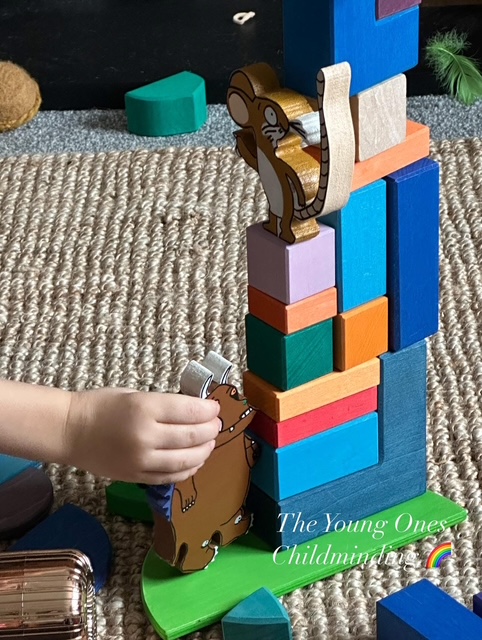
    When a child builds a tower, they’re not only playing – they’re learning balance, spatial awareness, and perseverance when it falls.
    When they make you “dinner” from leaves and mud in the garden, they’re developing social skills, sequencing and role play.
    When they paint with their hands or squish playdough, they’re strengthening fine motor skills and processing sensory input.

    You Don’t Need Fancy Toys or Perfect Pinterest Setups

    We live in a world of curated crafts and colour-coordinated toy rooms, but let’s get this straight: you do not need to be a play expert or have a Montessori-certified space to support your child’s development.

    Some of the best play happens with the simplest things:

    • Pots and pans and a wooden spoon
    • A cardboard box (a spaceship! a shop! a den! The possibilities are endless!)
    • Scarves to twirl, animals to line up, pegs to sort
    • A puddle and some wellies

    You don’t need more stuff – you just need space for imagination.

    “But I’m Not Good at Playing…”

    You don’t have to be!
    You don’t need to be on the floor all day long pretending to be a dinosaur or customer at the café. Your role is to offer the environment, encourage curiosity, and sometimes join in—but it’s okay to step back too. Independent play is healthy and important.

    One powerful way to connect is by noticing what your child’s doing and commenting, not directing.

    “Wow, you used all the blue blocks!”
    “I can see you’re working so carefully on that tower.”
    “That dragon looks fierce!”

    This shows them you value their play – and their thinking.

    Play Builds Brains and Confidence

    Through play, children:

    • Build emotional resilience (taking turns, trying again, expressing feelings)
    • Develop language (narrating, naming, story-making)
    • Strengthen their bodies (running, climbing, balancing)
    • Learn how to be with others (cooperation, empathy, self-resilience, self-confidence and self-control)

    We don’t need to rush them to academics and formal classroom education. All of that learning? It’s already happening – in the block corner, at the water tray, in the back garden.

    Let Them Lead

    One of the greatest gifts we can give children is time to explore their interests, even if it means getting a little messy or noisy. Let them follow their curiosity. Ask open-ended questions. Offer time and space, not pressure.

    When we protect play, we protect joy and joy is where real learning begins.

    Leave a comment

    Pages: 1 2