After a few recent conversations with other practitioners, I realised how much confusion there still is around core provision and enhanced provision. Not because people aren’t doing it — but because they often don’t recognise that they already are.
I wanted to share what this looks like in my own setting, not as a checklist or a “this is how you should do it”, but as a real, lived example — mess, movement, space limitations and all.
What core (or continuous) provision really means to me
For me, core provision is about familiarity, accessibility, and trust.
It’s the resources that are always available to children — the ones they return to again and again, building on ideas, revisiting learning, and deepening their play over time. These resources don’t need to be flashy or constantly changed. In fact, their power lies in their consistency.
In my setting, I don’t have a large, dedicated space where everything lives permanently. Storage is something I’ve had to think carefully about, because how resources are stored has a huge impact on how effective core provision actually is. Some areas rotate where they’re stored simply because of space — but the key thing is that the resources themselves are always readily available to the children.
Core provision isn’t about where something sits. It’s about whether children know it’s there, can access it independently, and feel confident using it.
Core provision inside and out
One thing that’s really important to me is that core provision happens both indoors and outdoors.
Children don’t separate their learning by walls, so I try not to either.
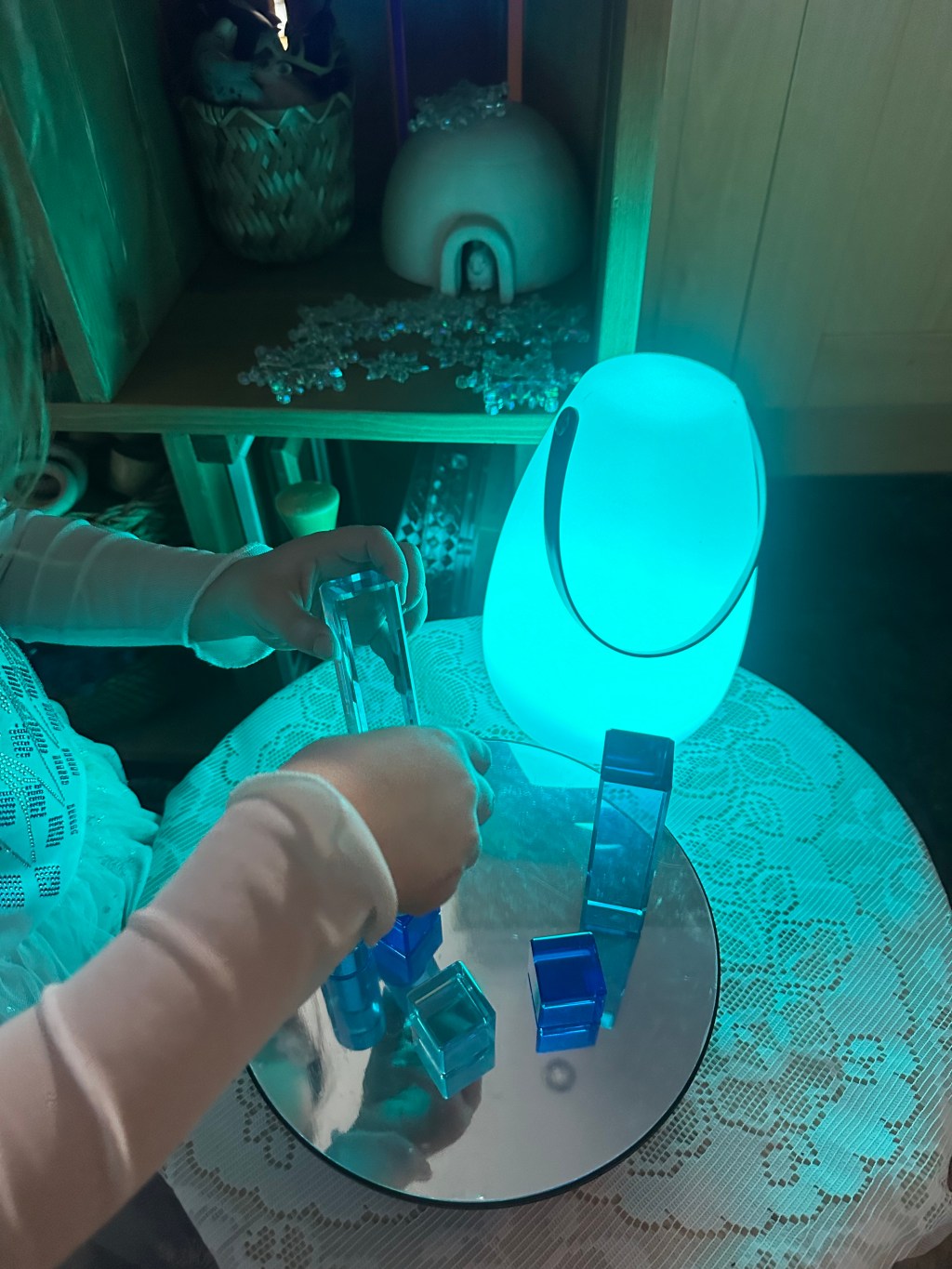
For example, construction is a huge part of our core provision. Indoors, children always have access to resources like wooden blocks, magnet tiles, acrylic cubes, cars, animals, and loose parts. Outdoors, that same interest is supported on a larger, more physical scale — with wooden planks (cut-down decking), pipes, tyres, guttering, foam blocks, and open-ended materials that allow for big ideas and gross motor play.
The resources are different, but the thinking is the same.
This continuity allows children to transfer ideas, revisit schemas, and explore concepts in ways that feel natural to them.
Open-ended, authentic resources
Another key part of our core provision is the use of real, authentic materials alongside more traditional resources.
In our home corner, children have access to real pots and pans, metal and wooden utensils, and items with different weights, textures, and sounds. Alongside this, we also have felt food and open-ended loose parts that children can transform into whatever their play requires.
You’ll find animals both inside and out — some wooden, some plastic — because children use them differently in different spaces. Natural loose parts like pinecones, stones, and shells are always available too, offering endless opportunities for imaginative play, schematic exploration, and sensory engagement.
Books as core provision
Books are woven throughout the setting, not confined to one area.
We have familiar, well-loved books that are always available — the ones children know by heart, request again and again, and use in their play. Alongside these, we rotate seasonal or interest-led books, often linking them to small world play or simple bookish invitations. Alongside this we always have books and materials that reflect and build on children’s cultural understanding, promoting diversity and inclusivity.
This is where enhanced provision gently comes in.
So what is enhanced provision?
Enhanced provision is not about replacing core provision or creating lots of new activities.
It’s about responding.
It might be:
- adding sensory/messy play provocation that is based round in interest or areas of development that you would like to support
- introducing a story/bookish play that reflects something children are acting out in play
- adding new loose parts, textures, or materials linked to a current interestChanging seasonal resources as the seasons change, and introducing books and materials linked to festivals and celebrations from around the world to broaden children’s experiences.
The core stays steady. The enhancement shifts and adapts.
EYFS — without forcing it
I’m always mindful of ensuring that our provision supports all areas of the EYFS, both indoors and outdoors. But I don’t do this by setting up separate “maths”, “literacy”, or “understanding the world” activities.
Instead, I make sure resources are accessible.
For children interested in numbers, there are resources with recognisable numerals available inside and out. For those drawn to mark-making or storytelling, there are always opportunities to explore literacy in meaningful ways. Construction naturally lends itself to mathematical thinking, problem-solving, and conversations about the world — from counting blocks to talking about homes, structures, and materials.
One resource often supports many areas of learning — and that’s exactly how it should be.
A gentle note on schemas
Although I won’t go into detail here, it’s worth mentioning that schemas play a big role in how children engage with core provision. When resources are consistent and open-ended, children can fully explore their schematic interests — whether that’s transporting, positioning, enclosing, rotating or more.
Understanding this has helped me refine our provision over time, and it’s something I’ll be sharing more about separately.
Less really is more
If there’s one thing I hope this offers, it’s reassurance.
Provision doesn’t need to be perfect.
It doesn’t need to be constant change.
And it certainly doesn’t need to look the same in every setting.
What matters is that children feel confident, curious, and capable in their environment — and that practitioners feel supported, not overwhelmed, by the expectations placed on them.
Chances are, you’re already doing far more than you realise.

 Guiding The Young Ones
Leave a comment