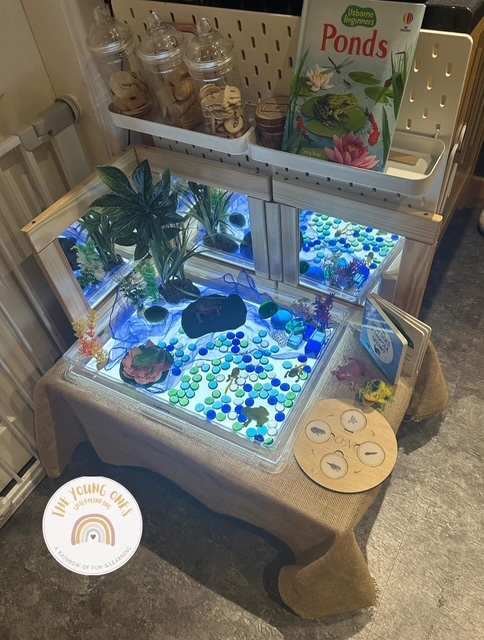


Some people have been asking why mirrors are often used in play and learning invitations, so I thought I’d share a few reasons why they can be such powerful additions to your provocations – both at home and in early years settings.
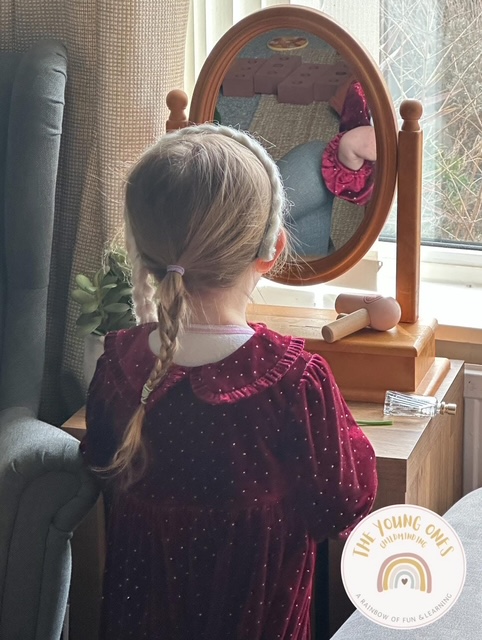
Mirrors reflect light, creating a visually stimulating environment that supports the development of visual senses and adds a whole new dimension to play. Children are naturally drawn to their reflections – they love seeing themselves and watching their play unfold in the mirror. This not only enhances self-awareness but can also support early communication, as children begin talking to themselves, making faces and expressing emotions through their reflections.
When observing children engaged in mirror play, you may notice moments of self-regulation, like children using what’s known as private speech – talking to themselves as they think through ideas or solve problems. In adult terms, this is like an inner monologue and it plays an important role in cognitive development.
Mirrors also present opportunities for children to explore the world from a different perspective. They can investigate symmetry, silhouettes, shadows, colours, reflection, luminosity and more. The ever-changing images offer endless possibilities for creative exploration and even the simplest materials can feel magical when mirrored.
Beyond the sensory and cognitive benefits, mirrors provide space for identity exploration. Children can observe their own movements, increasing body awareness and developing a stronger sense of self.
Whether placed under a light tray, alongside natural loose parts, or propped up outdoors next to leaves and petals, mirrors invite children to look closer, think deeper and imagine more boldly.
So if you’re looking to enrich your next play setup, try adding a mirror. You might just be surprised by what reflects back!


Leave a Reply