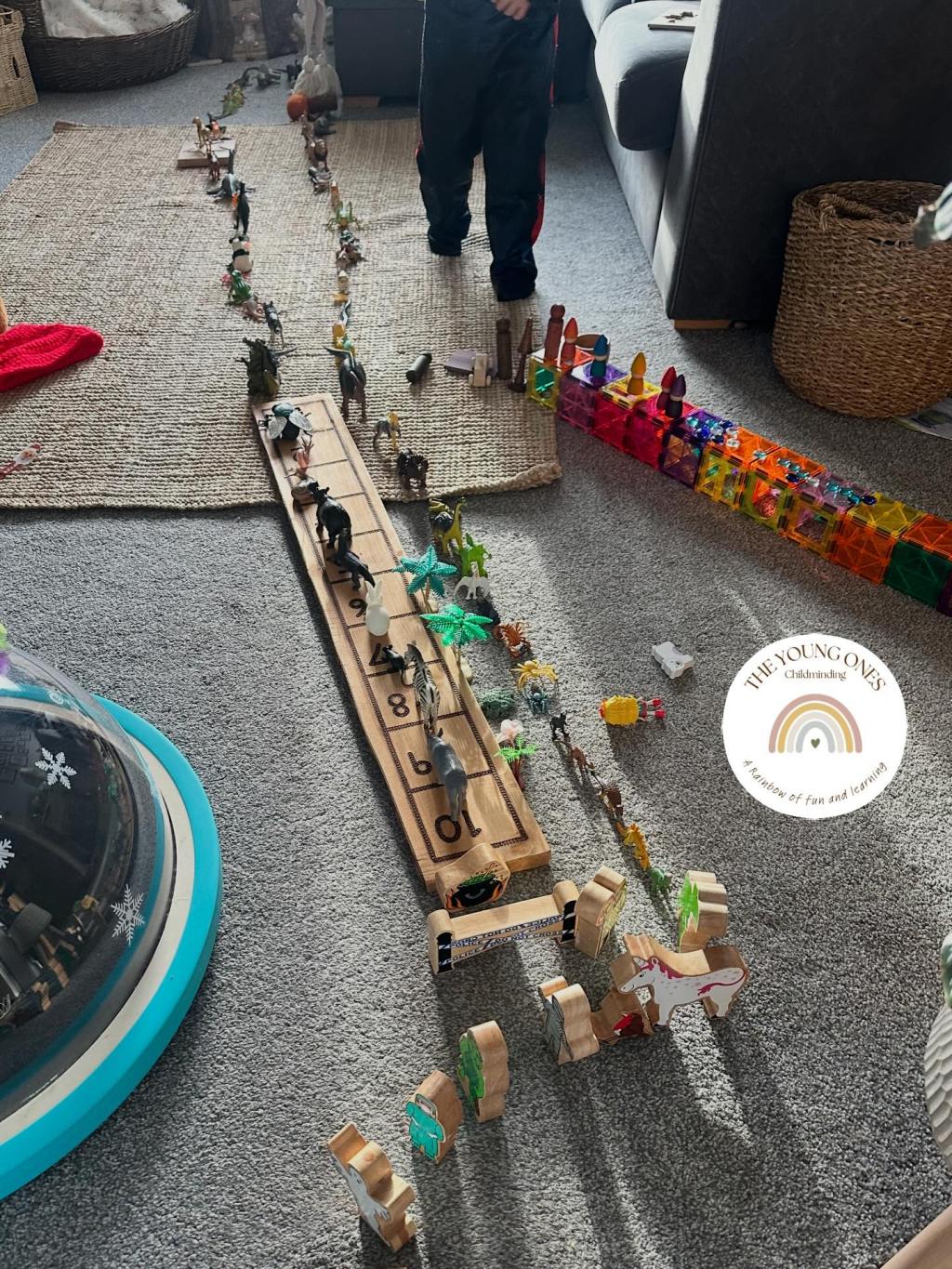
Understanding schematic play often brings clarity.
But translating that understanding into everyday practice takes time, reflection, and confidence.
Supporting schematic play doesn’t mean having everything out, asking constant questions, or getting it “right” all the time. It’s about creating a responsive environment where children’s thinking is valued, while also protecting shared spaces and practitioner wellbeing.
Below are practical, gentle approaches that support schematic play in a way that feels sustainable.
1. Strong continuous provision comes first
Before enhancements, provocations, or additions, strong core continuous provision matters.
When children have consistent access to:
- open-ended materials
- loose parts
- spaces to build, move, pour, connect, and arrange
They don’t rely on constant adult input to explore their ideas.
A well-considered base environment allows schematic play to emerge naturally, without the need to add more and more resources.
Enhancements should respond to children’s interests – not replace what is already working.
2. Enhance thoughtfully, not excessively
As we observe children’s interests, it can be tempting to add lots of resources quickly. But more isn’t always better.
Enhancement works best when it is:
- intentional
- following the interests simply and building on them
- rooted in observation
Sometimes one additional resource, placed with care, can extend play far more effectively than a full change of environment or invitation.
This also helps protect the environment from becoming overwhelming – for children and adults alike.
3. Seeing deeper as understanding grows
As schematic knowledge develops, practitioners often begin to notice play more deeply.
What once appeared to be an interest in one thing may actually be something else entirely.
For example:
- A child repeatedly spinning a wheel may not be interested in spinning, but in how things work
- A child pouring water into containers may not be focused on “containing”, but on movement, flow, and gravity (trajectory).
- A child carefully positioning offence on his farm may not be interested in the positioning but more than enclosure.
This deeper understanding reminds us to reflect before assuming. It also means being willing to adapt our provision when new insights emerge. There may be times when we set up an invitation based on what we think a child will want to explore, only for them to show us something entirely different. This doesn’t mean the invitation has failed. Instead, it offers valuable insight into the child’s thinking. Adapting in response is a strength – it shows that we are truly noticing, listening, and responding to a child’s needs.
4. Reflect often – intervene selectively
Reflection is essential. Constant intervention is not.
As practitioners, we don’t always need to:
- ask questions
- narrate play
- extend learning verbally
In fact, well-intentioned questioning can sometimes interrupt deep concentration and disrupt the natural flow of schematic play.
Learning when to step back is a skill in itself, and one it’s taken me time to develop. Sometimes the most respectful response is to observe quietly and allow children the space to think.
5. Support actions, not just activities
Schematic play is about repeated actions rather than specific activities.
Instead of focusing on what children are using, consider:
- what they are doing
- what action keeps repeating
- how the environment supports or limits that action
This approach helps practitioners respond flexibly, without feeling pressure to plan for every outcome.
6. Use duplication as a supportive tool
When children repeatedly move resources between areas, small amounts of duplication can support continuity.
Providing similar tools in different spaces can:
- reduce frustration
- support independence
- protect sustained play
Duplication doesn’t need to be extensive – just thoughtful.
7. Boundaries support wellbeing and learning
Supporting schematic play does not mean unlimited access to everything.
Boundaries help protect:
- safety
- shared spaces and play
- emotional regulation
- practitioner capacity
Gentle boundaries might include:
- limiting quantities rather than stopping play entirely
- offering alternative spaces for large scale exploration
- returning to play later rather than stopping it completely (pausing play with explanation, not urgency)
Children benefit from boundaries that feel calm and respectful, not rushed or reactive.
8. Protect flow where possible
Schemas thrive in uninterrupted time.
Whenever possible:
- allow play to continue
- delay tidying if learning is still unfolding (even if that means doing some tidying but not the unfinished learning process)
- return to play later
Flow is fragile. Protecting it supports deep engagement, problem-solving, and confidence.
9. Practitioner wellbeing matters
Schematic play can be noisy, expansive, and intense at times.
There will be days when:
- the environment feels too full
- your capacity feels stretched
- stepping in feels necessary
That doesn’t mean schematic play isn’t being supported.
It means wellbeing is being protected – and that matters too.
A calm, regulated adult is far more valuable than a perfectly resourced environment.
A final reflection
Supporting schematic play is not about doing more.
It’s about seeing more.
Seeing intention instead of mess.
Seeing thinking instead of behaviour.
Knowing when to step in – and when to step back.
That balance takes time, and that’s okay.
When we allow ourselves that grace, we create environments where children feel understood – and where we feel more confident, calm, and grounded in our practice.

 Guiding The Young Ones
Leave a comment